Head of the Class: Why Vintage Racing Helmets Are the Hottest Investment in Motorsports Collecting
For decades, the autograph was the crown jewel of racing memorabilia. A signature on a die-cast, a photo, a program — it was the clearest signal that you'd gotten close to the person behind the wheel. But something has changed in how the most dedicated collectors think about their hobby, and the shift is pointing straight at the shelf where helmets live.
Vintage racing helmets are having a moment. More accurately, they're having an era — one that's been building quietly for years and is now impossible to ignore if you're paying attention to where serious money is moving in this market.
Why a Helmet Hits Different
Start with what a helmet actually is. It's not a souvenir produced for fans. It's not a marketing asset designed to be signed and distributed. It's a piece of safety equipment that sat on a driver's head during the most intense moments of their professional life. It absorbed the heat, the noise, the G-forces, and the focus of races that mattered.
That physicality creates a kind of connection that signed merchandise fundamentally cannot. When you hold a helmet worn during a landmark race — a championship run, a famous comeback, a career-defining performance — you're holding the object that was closest to the driver's mind during those moments. That's not a sentimental observation. It's the core reason serious collectors are willing to pay serious prices.
Autographs, by contrast, are largely transactional. A driver signs hundreds of items over the course of a career, often quickly, often at events specifically designed for that purpose. The signature is authentic, but the object beneath it is usually generic. Helmets are the opposite — inherently specific, inherently personal, and produced in quantities that make scarcity a structural feature rather than a marketing claim.
The Authentication Challenge — and Why It Matters
Here's where helmet collecting gets genuinely complicated, and where the opportunity lives for collectors willing to do their homework.
Authentication in the helmet market is legitimately difficult. Unlike some collectibles categories with established grading authorities, vintage racing helmets require a multi-layered verification process. You're looking at manufacturer records, team documentation, photographic evidence from race coverage, and physical characteristics of the specific model produced during a given era. A helmet from the early 1980s has specific construction details — liner materials, visor mechanisms, shell composition — that differ from era reproductions in ways that require real expertise to identify.
The murky authentication landscape has two effects. It creates risk for buyers who don't know what they're doing, and it creates genuine opportunity for collectors who develop real expertise. When you can reliably identify authentic race-used helmets in a market where plenty of buyers can't, you're positioned to find value that others overlook.
This is one of the strongest arguments for building relationships with knowledgeable dealers who specialize in race-used equipment. The due diligence that goes into a significant helmet purchase — cross-referencing period photographs, checking manufacturer serial records where they exist, consulting with people who have hands-on experience with specific eras and series — is exactly the kind of work that experienced shop staff at places like Last Lap Corner Store can help you navigate.
Reading the Market
The data, where it's available, tells an interesting story. Helmets associated with specific historic moments — final-lap passes, championship-clinching races, events that entered the sport's permanent memory — have shown consistent appreciation over the past decade. The category has benefited from the broader growth in sports memorabilia as an alternative asset class, but it's also driven by something more organic: a generation of fans who grew up watching specific drivers and are now in their peak earning years with the resources to chase meaningful pieces.
The vintage American motorsports market has particular depth in this category. Decades of NASCAR history, CART and IndyCar racing, IMSA sports car competition, and regional short-track scenes have produced enormous amounts of authentic race-used equipment. Much of it has been sitting in garages, estate collections, and the inventories of smaller dealers who acquired it without fully understanding what they had.
That distribution pattern creates a market where patient, knowledgeable buyers can still find genuine value. The era of easy flips on obvious pieces may be tightening, but helmets from mid-tier drivers, regional champions, and historically significant but under-appreciated moments remain more accessible than many collectors realize.
What to Look For
If you're considering entering this category, a few principles will serve you well.
Provenance documentation is everything. A helmet with a clear, documented chain of custody — team records, correspondence, original purchase receipts, photographic evidence of race use — is worth considerably more than a physically identical helmet with a vague backstory. Never let a compelling physical appearance substitute for documented history.
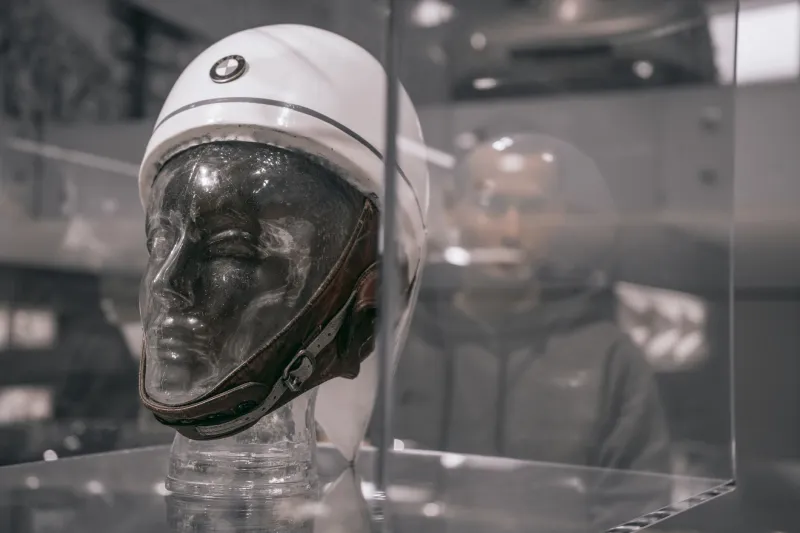
Period-correct construction details matter enormously. Learn the specific characteristics of helmets produced by major manufacturers during the decades you're targeting. Bell, Simpson, Shoei, and others produced distinct models in specific eras with identifiable features. A helmet that doesn't match the construction profile for its claimed period is a significant red flag.
Condition assessment requires nuance. Unlike many collectibles, wear on a race-used helmet is often a feature rather than a flaw. Genuine use leaves specific patterns — visor scratches consistent with debris impact, liner compression from actual wearing, radio communication hardware wear — that differ from artificial aging. Learning to read those patterns is a genuine skill.
The Long View
Vintage racing helmets occupy a category that's still developing its institutional infrastructure. The authentication standards, the price references, the specialist networks — all of it is more mature than it was ten years ago and less mature than it will be ten years from now. That developmental phase is historically when collectors who invest in expertise see the strongest returns.
For fans who want their collection to mean something beyond shelf decoration, helmets offer a depth of connection that's genuinely rare in any collecting category. They're wearable history in the most literal sense — objects shaped by the specific humans who wore them in specific moments that mattered. That's a hard thing to put a price on, and a harder thing to replicate.