Wrench Like the Pros: Setting Up Your Home Garage the Pit Crew Way
Every Sunday afternoon, millions of fans watch pit crews swap four tires, fuel a car, and make adjustments — all in under 12 seconds. It's one of the most impressive displays of organized human effort in all of sports. But here's the thing most people miss: that level of efficiency didn't happen by accident. It was designed. Every tool has a place, every person has a role, and every square inch of that pit box serves a purpose.
Now, you're probably not changing tires at 200 mph on a Sunday. But your garage? That deserves the same respect. Whether you're doing weekend wrenching on a project car, maintaining your daily driver, or just trying to stop tripping over that socket set you swear you put somewhere, there's a lot to borrow from professional pit crew culture. Let's get into it.
Start With the Mindset, Not the Money
Before you drop a single dollar on pegboards or tool chests, take a beat and think like a crew chief. Professional racing teams don't just buy expensive gear and call it a day — they build systems. The most important question you can ask yourself before reorganizing your garage is: what tasks do I actually perform here, and in what order?
A home mechanic doing oil changes, brake jobs, and suspension work needs a completely different layout than someone who restores vintage muscle cars or builds custom exhausts. Map out your most common workflows first. That mental blueprint is worth more than any fancy cabinet set.
This is the pit crew mindset: every movement has a cost, and unnecessary movement is waste. In a real pit stop, a tire carrier who takes two extra steps to grab the gun costs the team tenths of a second. In your garage, wasted steps cost you frustration, time, and sometimes safety.
The Sacred Workbench: Your Command Center
If the pit box is the heartbeat of a racing team's race-day operation, your workbench is the heartbeat of your garage. And yet, the average home workbench is basically a horizontal dumping ground. Receipts, random bolts, a half-eaten granola bar from three months ago — you know the vibe.
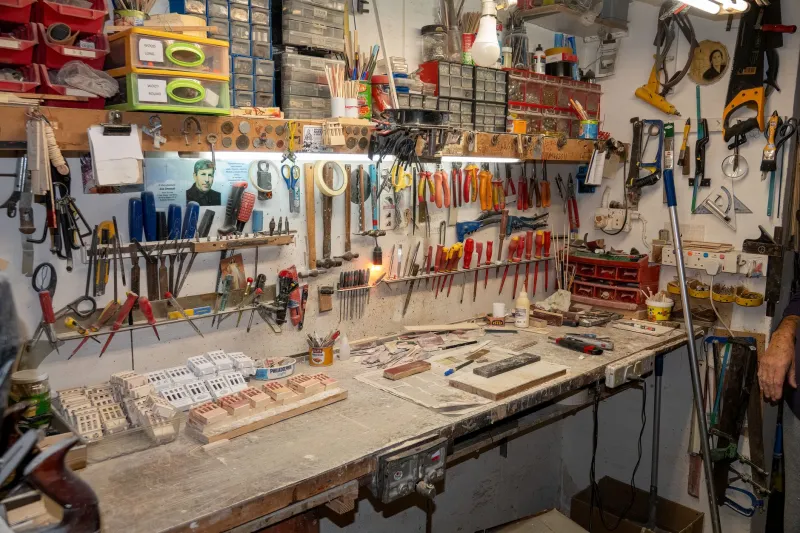
Here's the fix: treat your bench the way a pit crew treats their equipment cart. Establish zones. A dedicated area for small parts and hardware (a magnetic parts tray does wonders here), a clear center workspace that stays clear, and a section for whatever project you're actively working on. That's it. Three zones.
Lighting is non-negotiable. Under-cabinet LED strips are cheap, bright, and will genuinely change how you work. Pit crews work under intense lighting for a reason — you can't torque a bolt correctly if you can't see it properly.
Also consider a pegboard directly above the bench for your most-used hand tools. Outline the tool shapes with a paint marker so you always know what's missing. This is a trick borrowed straight from professional pit crew setups, and it works just as well in a two-car garage in Ohio.
Smart Storage: A Place for Everything
Professional pit crews operate with what's called "shadow boards" — panels with cutouts shaped exactly like each tool, so a missing item is immediately obvious. You don't need to go full NASCAR fabrication shop, but the principle absolutely applies at home.
Here's a practical breakdown of storage priorities:
Rolling Tool Chest: This is your workhorse. Go for a chest with deep bottom drawers for larger tools and shallow top drawers for sockets, wrenches, and bits. Organize by function, not just size. Keep everything you'd use in a brake job together, everything for an oil change together, and so on. Task-based organization beats alphabetical or size-based every single time.
Wall-Mounted Shelving: Use vertical space aggressively. Heavy items like fluids, jack stands, and parts bins belong on lower shelves. Lighter, less-used items go higher. Label everything — even if you think you'll remember where something is, you won't at 10 PM on a Saturday when you're elbow-deep in an engine bay.
Parts Bins and Small Hardware Organizers: Clear bins with labels are your best friends. Fasteners, clips, electrical connectors — these things disappear into the void if they don't have a home. Stackable clear bins mounted to a wall or sitting on a shelf keep small parts visible and accessible.
Floor Space: Protect it fiercely. Keep the floor clear of everything that doesn't need to be there in the moment. Interlocking foam floor tiles are a solid investment — they're easier on your knees, reduce fatigue during long jobs, and clean up oil spills much easier than bare concrete.
The Safety Pit Lane: Don't Skip This
Pit road has speed limits for a reason. Safety in a professional pit environment is taken incredibly seriously, and your home garage should be no different. A few essentials that are easy to overlook:
- Fire extinguisher mounted near the exit — not buried behind boxes
- First aid kit that's actually stocked and accessible
- Proper jack stands — never rely solely on a floor jack
- Eye wash station or at minimum, a dedicated eyewash bottle near your workbench
- Ventilation — if you're running an engine indoors, carbon monoxide is a real and serious hazard
Hang a small dry-erase board or whiteboard near your main workspace. Use it to jot down what you're working on, what parts are on order, and any safety notes for that job. It sounds simple, but having that running log visible keeps you from making the kind of mistakes that happen when you're tired or distracted.
Workflow Habits That Actually Stick
Here's where the real pit crew magic happens — and it has nothing to do with tools. Professional crews run through pre-race checklists, post-race debriefs, and constant process reviews. They never assume a job went well just because the car made it around the track.
Adopt a simple version of this. Before you start any job, lay out every tool you'll need. After you finish, do a five-minute cleanup and put everything back where it belongs. That's it. That one habit, done consistently, will transform how your garage feels and functions within a month.
Also, resist the urge to buy more stuff as the primary solution to disorganization. More tools don't fix a broken system — better habits do. The best pit crews in the world could operate effectively out of a smaller space because their processes are tight. Same principle applies to your garage.
The Last Lap Takeaway
Your garage doesn't need to look like a professional racing team's hauler to function like one. It just needs intention. Think about your workflows, give every tool a home, protect your floor and your safety, and build habits that keep the whole thing running smoothly.
And hey — if you want to add a little racing flair to the space while you're at it, we've got you covered. A few well-placed pieces of racing memorabilia, some team signage, or even a vintage racing poster can turn a functional garage into a space you're genuinely excited to spend time in. Because at the end of the day, the best garage is one you actually want to work in.
Now go flag down that project car. It's been waiting long enough.